

Best Dog Steps for High Beds: How to Choose the Right Height, Rise, and Support

A high bed is one of the pleasures of a beautifully made bedroom — and one of the longest jumps your companion makes all day. Choosing the right dog steps begins with two measurements most shoppers never take: the height of each individual step, and the height of the surface your dog needs to reach. Get those two numbers right and nearly everything else falls into place.
Key Takeaways
- The best dog steps for a high bed reach within one natural step of the mattress top — for tall beds of 22–28 inches, that typically means a 4-step design at 28 inches.
- Choose by step rise first: about 7 inches suits most medium and large dogs, while small and short-legged companions need a lower 4.75–5.25 inch rise.
- High-density foam steps are gentler on joints than wood or plastic, and stable enough to support the weight of a human.
- Removable, machine-washable covers in upholstery-grade micro suede keep foam stairs practical for everyday bedroom use.
- Stairs are not bad for dogs — repeated jumping from tall furniture is the strain to avoid, especially for seniors, puppies, and post-op companions.
What are the best dog steps for a high bed?
The best dog steps for a high bed are foam stairs whose top step lands within one natural step of the mattress surface, with a step rise matched to your dog's leg length. For tall beds, the Animals Matter® Companion Stairs® 4-Step reaches 28 inches with a consistent 7-inch rise.
Height alone is not the whole answer. A staircase tall enough for the bed but with a rise too steep for the dog simply moves the jump from the mattress to the steps. That is why we recommend choosing in a specific order — rise first, height second.
How tall should dog stairs be for a high bed?
Dog stairs should reach within roughly one step rise — about 7 inches — of the mattress top, so the final step onto the bed feels like every other step. Measure from the floor to the top of the mattress, including any topper, then choose the stair height that closes that gap.
This is the heart of what we call the Rise-First Fit Method, the same fit philosophy behind our inner-resting-area approach to bed sizing: match the equipment to how your companion's body actually moves, then to the furniture.
- Measure the bed — floor to mattress top, topper included. Tall and pillow-top beds commonly measure 24 to 28 inches.
- Match the rise to your dog — about 7 inches for most medium and large dogs; 4.75 to 5.25 inches for small, short-legged, or senior companions.
- Match the total height to the bed — the top step should land within about one rise of the mattress surface.
- When in doubt, go taller — a slightly taller staircase with the correct rise beats a shorter one that reintroduces a jump.
| Bed or furniture height | Recommended steps | Total height | Step rise |
|---|---|---|---|
| Up to ~14" (low platform, sofa seat) | Companion Stairs® 2-Step | 14" | 7" |
| 15–21" (standard bed, deep sofa) | Companion Stairs® 3-Step | 21" | 7" |
| 22–28" (tall, pillow-top, high bed) | Companion Stairs® 4-Step | 28" | 7" |
| Small dogs on beds and sofas | Mini Companion Stairs® 3- or 4-Step | Two heights | 4.75–5.25" |
| Small, long-bodied, or back-sensitive dogs | Companion Ramp® | 14" or 21" | Gentle incline |

What are the best dog steps for large dogs?
Large dogs need steps with a full-depth tread, a stable core, and a rise near 7 inches — tall enough to climb efficiently, low enough to spare the shoulders and hips. The Companion Stairs® are built from high-density CertiPUR-US® certified foam components, sturdy enough to support the weight of a human.
Stability is the detail large-dog owners feel first. A 70-pound companion descending at speed loads the front of every step; high-density foam absorbs that landing without skating across the floor or drumming like hollow plastic. For aging large breeds — and for the owners who can no longer lift them — a properly fitted staircase is the difference between independence and a nightly carry. Pair the stairs with an orthopedic dog bed and the bedroom works for your companion's joints around the clock.
Are foam dog stairs better than wood or plastic?
For bedroom use, yes. High-density foam stairs are gentler on paws and joints, quieter, lighter to reposition, and safer around shins and walls than wood or plastic. The trade-off — less weather resistance — rarely matters indoors, which is why foam is the standard for bedside steps.
Construction quality decides whether foam feels supportive or mushy. Our Companion-Pedic® foam — the same proprietary support system used in our orthopedic beds — is made in Southern California using CertiPUR-US® certified foam components, tested for content, emissions, and durability. Each staircase is upholstered in durable, upholstery-grade micro suede with a removable cover that unzips for cold-water machine washing and line drying.
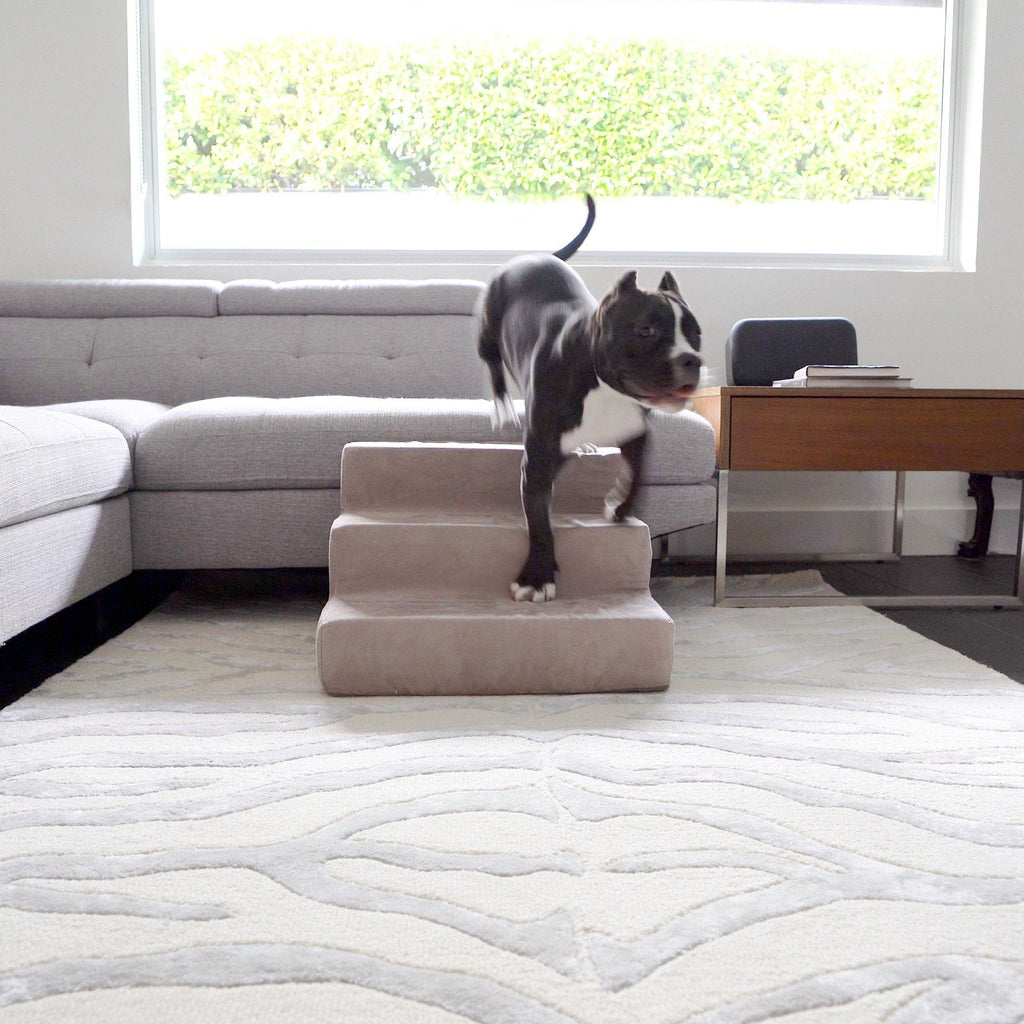
Are stairs bad for dogs?
No — stairs with a properly matched rise are protective, not harmful. The movement that strains joints is repeated jumping on and off tall furniture, which loads the front limbs with several times the dog's body weight. Steps replace that impact with a controlled climb. Dogs with diagnosed orthopedic conditions should follow their veterinarian's guidance.
The exception is fit. Steps with a rise too tall for the dog — human-scale stairs, for instance — force a hop on every tread. That is why small and short-legged companions should use a 4.75–5.25 inch rise rather than the standard 7 inches, a distinction we cover in depth in our guide to dog stairs for small dogs.
What about puppies and small dogs on high beds?
Puppies and small dogs can use steps to a high bed when the rise matches their stride — the Mini Companion Stairs® keep each step at 4.75 to 5.25 inches with a wider tread for confidence. For long-bodied or back-sensitive small breeds, a gentle incline like the Companion Ramp® is often the better fit.
Puppies of larger breeds deserve a special note: their growth plates are still forming, so the jumping habit is best never learned. Steps introduced early become the default path on and off furniture for life. Unsure between the two formats? Our comparison of dog stairs vs. dog ramps walks through the decision by body type.
Can my dog use stairs after ACL or TPLO surgery?
Only on your veterinarian's timeline. Post-surgical recovery from ACL or TPLO procedures follows a staged rehabilitation plan, and reintroducing stairs — even low-rise foam steps — belongs to the stage your surgeon defines, not to a general rule. What steps can do is remove the far riskier alternative: an unsupervised leap off the bed.
Many rehabilitation plans eventually favor a low, predictable rise over jumping of any kind, which is why post-op companions are among the most common Companion Stairs® households. Bring the dimensions — 7-inch rise, or 4.75–5.25 inches on the Mini — to your vet and let them call the timing.
Should you build DIY dog stairs for a high bed?
You can build serviceable dog stairs, but matching a safe design is harder than it looks: a consistent rise, a tread deep enough for the dog's full stance, a surface with traction, edges that forgive a stumble, and a structure that will not shift under a running dog. Most DIY builds miss at least one.
If you enjoy the project, build to the same numbers we manufacture to — a 7-inch rise for medium and large dogs, about 5 inches for small ones, and a top platform within one rise of the mattress. If you would rather it simply be solved — beautifully, in micro suede that matches the bedroom — that is what the Companion Stairs & Ramps collection is for.
How do you teach a dog to use steps to the bed?
Most dogs learn bedside steps in a few short sessions: place the stairs permanently against the bed, lure one step at a time with a treat, reward at the top, and practice the descent last — going down is the harder skill. Keep sessions brief and never force a fearful dog upward.
- Anchor the location. Place the steps against the bed where they will permanently live; dogs trust fixtures, not furniture that moves.
- Lure, don't lift. Guide your companion one tread at a time with a treat at nose height; lifting them onto the stairs skips the learning.
- Reward at the top. The bed itself becomes the prize; a treat and praise on the mattress seals the association.
- Teach the descent separately. Going down asks more of the shoulders and confidence; reward each controlled step and block the urge to leap from halfway.

Which Animals Matter steps fit your companion?
| Companion Stairs® | Mini Companion Stairs® | Companion Ramp® | |
|---|---|---|---|
| Best for | Medium & large dogs; high beds | Small dogs, cats, short legs | Small, long-bodied, back-sensitive dogs |
| Step rise | 7" | 4.75–5.25" | Gentle incline, scalloped tread |
| Heights | 2-, 3-, 4-Step (14–28") | Mini 3- and 4-Step | 14" and 21" |
| Construction | High-density CertiPUR-US® certified foam components · upholstery-grade micro suede · removable, machine-washable covers · designed in California | ||
Built for years of bedtimes
A staircase your companion uses ten times a day is not an accessory; it is daily orthopedic infrastructure. Animals Matter steps and ramps are designed in California and artfully hand crafted with the same Companion-Pedic® foam philosophy as our orthopedic beds, upholstered to live beautifully in a considered bedroom, and built so the right choice only has to be made once. Seniors who need gentler access often pair their stairs with an easy-entry senior dog bed for the same reason: the kindest homes remove the jumps.
Frequently Asked Questions
What are the best dog steps for a high bed?
The best dog steps for a high bed are foam stairs whose top step lands within one natural step of the mattress surface, with a step rise matched to your dog's leg length. For tall beds of 22 to 28 inches, the Animals Matter Companion Stairs 4-Step reaches 28 inches with a consistent 7-inch rise.
How tall should dog stairs be for a high bed?
Dog stairs should reach within roughly one step rise — about 7 inches — of the mattress top. Measure floor to mattress top including any topper, then choose the height that closes the gap: 14, 21, or 28 inches across the Companion Stairs line.
What are the best dog steps for large dogs?
Large dogs need a stable core, a full-depth tread, and a rise near 7 inches. Animals Matter Companion Stairs are built from high-density CertiPUR-US certified foam components and are sturdy enough to support the weight of a human.
Are stairs bad for dogs?
No — stairs with a properly matched rise are protective. The harmful movement is repeated jumping off tall furniture, which loads the front limbs with several times the dog's body weight. Dogs with diagnosed orthopedic conditions should follow their veterinarian's guidance.
Can my dog use stairs after ACL or TPLO surgery?
Only on your veterinarian's timeline. Reintroducing stairs after ACL or TPLO surgery belongs to the rehabilitation stage your surgeon defines. Low-rise steps are often eventually preferred over any jumping; bring the step dimensions to your vet and let them call the timing.
Should I choose dog stairs or a dog ramp for a high bed?
Choose stairs for most dogs; choose a ramp for small dogs with long backs, short legs, or back sensitivity. The Companion Ramp is designed for small companions only, while the Companion Stairs serve medium and large dogs up to 28-inch beds.
Are foam dog stairs washable?
Yes. Animals Matter Companion Stairs covers are removable, upholstery-grade micro suede that unzips for cold-water machine washing and line drying — no heat, bleach, or bleach alternatives. The foam itself should be spot cleaned, not machine washed.
How do I teach my dog to use steps to the bed?
Place the stairs permanently against the bed, lure one step at a time with a treat, reward at the top, and teach the descent separately — going down is the harder skill. Most dogs learn in a few short sessions; never force a fearful dog upward.
Explore refined access designed around the way your companion moves, rests, and lives: Companion Stairs & Ramps · Orthopedic Dog Beds · Senior Dog Beds · How to Choose the Right Luxury Dog Bed